-
Created by
 Palindar, last updated on Feb 07, 2025
6 minute read
Palindar, last updated on Feb 07, 2025
6 minute read
This guide explains how to install the free, open-source ComfyUI Portable with Hunyuan3D-2 on your local Windows PC. Its possible to install on linux/mac with nvidia using the exact same steps but the script is for Windows. Using this setup, you can quickly generate game-ready placeables, creatures, or tileset parts from either a 2D image or a text prompt, producing fully textured 3D models with UV mapping. The AI intelligently predicts the 3D shape and even generates unseen textures based on the image input. (Check out the example screenshots of a gorilla’s 2D image on a white background and its resulting 3D model in Blender.)
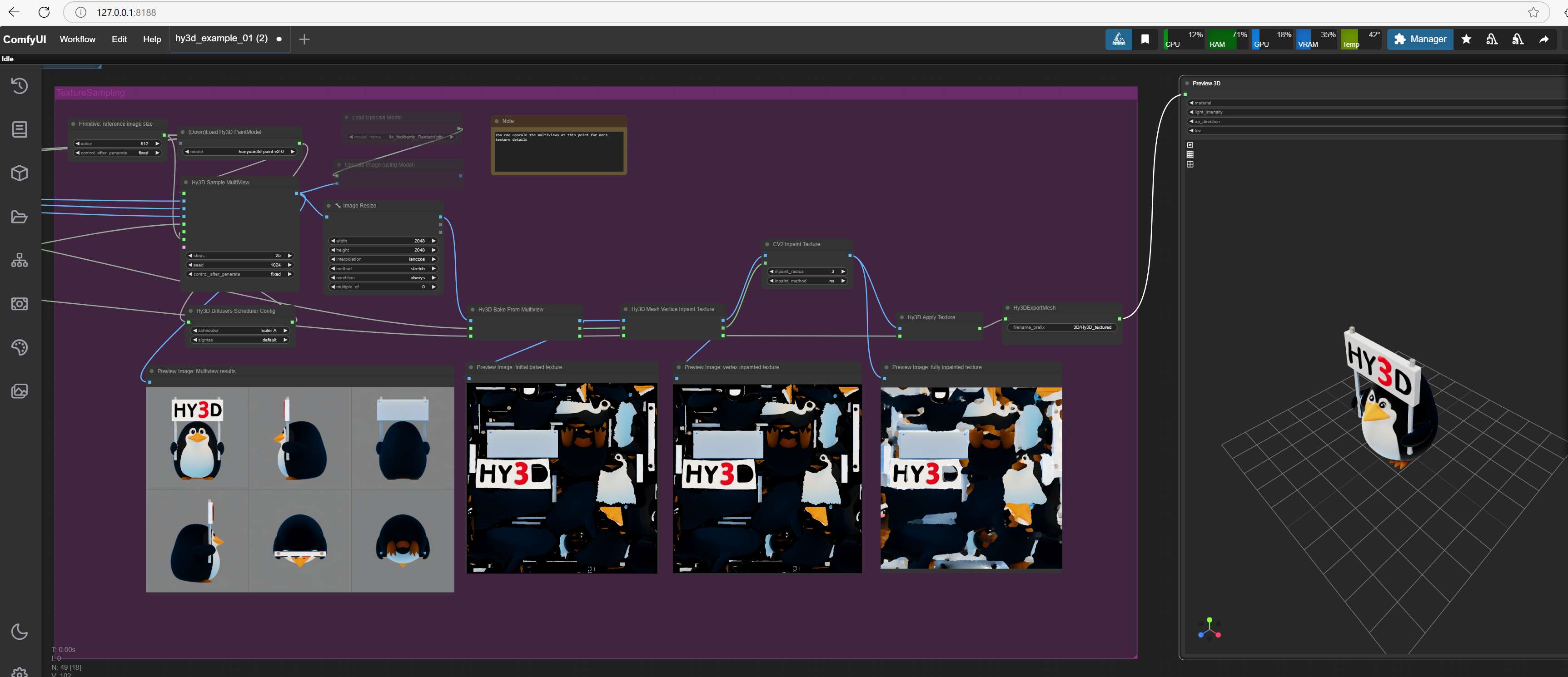
Generating a 3D model with textures typically takes 1 to 3 minutes, depending on your chosen quality settings and PC hardware. If you have an Nvidia GPU, you’ll achieve faster and higher-quality results. However, if you don’t have an Nvidia card, you can use your CPU (slow choice) or try an online service.
Free Online 3D Model Generation (Hugging Face)
If you prefer an online option, Hugging Face offers a free 3D model generator powered by Hunyuan3D-2, accessible here:
🔗 Hunyuan3D-2 on Hugging Face
This online version has a fixed face count of 50K, and while the results can be impressive, they lack the fine-tuned control available in ComfyUI.
Tip: Explore the Advanced Settings section for extra customization options. However, they are still more limited compared to a local ComfyUI installation.
Local ComfyUI vs. Online Services
If you want full control over settings like polygon count, texture resolution, and quality, a local installation of ComfyUI is the best choice. Some third-party providers also offer hosted ComfyUI instances with a pay-per-use model.
On Hugging Face’s free tier, you can generate three models per day before needing to purchase credits. However, if you have a 6GB+ VRAM Nvidia GPU and at least 24GB RAM, you can generate higher-quality 3D models directly on your PC within minutes.
ComfyUI: AI-Powered 3D Model Generation from 2D Images or Text
ComfyUI and its AI model generators allow you to generate 3D models with textures and UV maps from either a 2D image or a text description. The AI intelligently reconstructs the missing parts of the image, creating a fully detailed 3D model ready for import into Blender.
Features & Capabilities
- Polygon Control: Generate models with exact faces count you want from low poly (5K faces) to high poly (250K+ faces).
- Texture Quality: Adjustable texture resolution, supporting up to 2K upscaled and detailed textures.
- Extensive open source plugin eco system: 2d AI image generators, Advanced upscalers, PBR texture generation and many more.
Sample generated AI 2d Image to 3D Gorilla Model
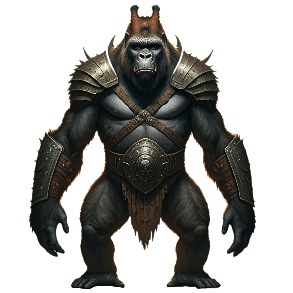
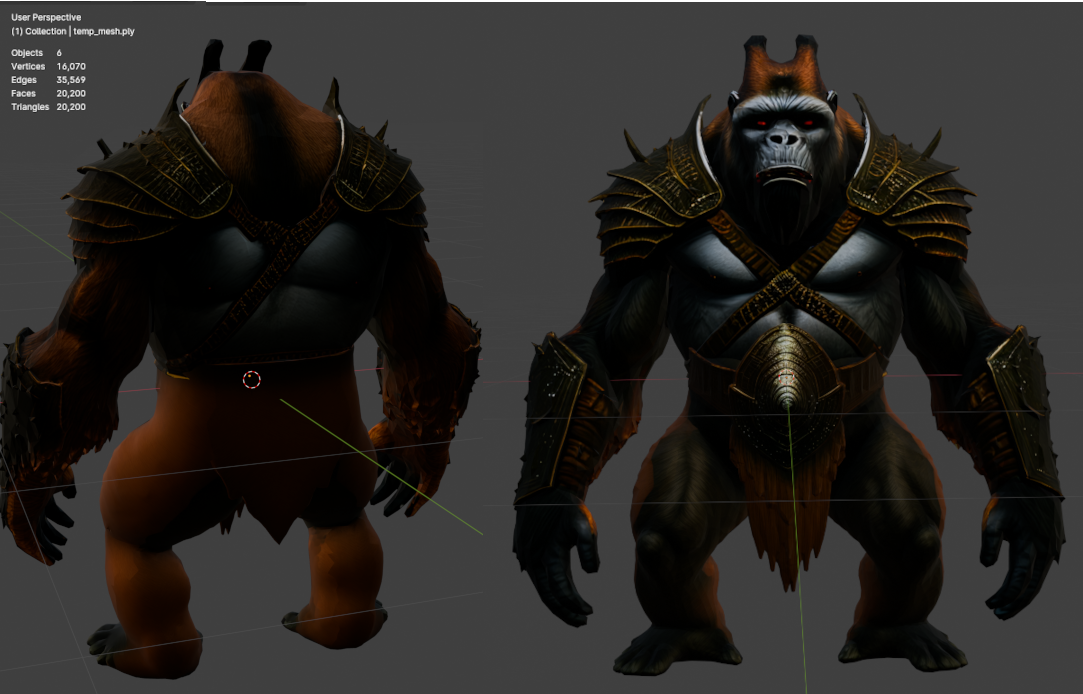
To demonstrate the capabilities of ComfyUI you can import the generated sample file in blender.

- Sample File: You can download and import HY3d_00118.glb into Blender to examine the 3D quality.
- Generation Settings:
- 10K faces
- 2K texture resolution
- Generation Settings:
The screen shot of Blender 3D gorilla model shown has 20K faces, which was achieved by splitting the original model into two meshes (top and bottom halves, each with 10K faces) by cropping the 2d image into two parts from the belt below legs, above torso, arms and head. This generated two 3d model meshes and was then merged as one model in Blender. This technique is useful for optimization for Neverwinter Nights, where the per-mesh face limit is 10K. Also breaking the model into meshes with less to create per part makes it more detailed and easier for the 3d generator limited texture memory.
Ease of Use & Batch Processing
📌 No programming or workflow setup is required— open the provided workflow and simply tweak a few parameters to match your hardware, and you can generate a fully textured 3D model in 1 to 3 minutes.
📌 Batch processing is supported, allowing you to generate multiple models at once with different images or settings.
Getting the Best Results from Your 2D Images
- For characters use a A-pose or T-pose facing front not at an angle and filling the whole picture frame to the edge
- Ensure a sharp, high-quality image with a plain white background
- Avoid weapons or accessories obstructing the body
- For placeables, use a clear, full-frame image with a white background not too many placeable items or parts in one scene.
- Fine tune settings in ComfyUI. Once you have a good workflow and settings it can be used over and over.
Fine-Tuning Settings for Best Results
To achieve high-quality 3D models and textures, it’s important to adjust a few key parameters:
✅ Num Faces – Controls polygon count
✅ Octree Rendering – Helps with structure refinement
✅ Steps Count – Affects model detail level
✅ Texture Size – Defines texture resolution
✅ Delight Settings – Adjusts texture lighting and color balance
✅ Upscaler 4x – Improves texture quality (OFF by default; should be turned ON). A 6x better quality ai upscaler extra plugin is recommended.
✅ Texture Memory Renderer – Recommended increase to 786MB or 1024MB (Default is 512MB, but at 1024MB, the AI may generate unintended details)
Extending Your Workflow
ComfyUI is open-source, meaning new features, plugins, and enhancements—such as other 3D or 2D AI generators, PBR texture processing and advanced upscalers—are continually being developed.
Installing ComfyUI with Hunyuan3D Workflow (Automatic Installer)
System Requirements
📌 Operating System: Windows 10 or 11 (Linux and Mac also but this install script is Windows bat file)
📌 Disk Space: 50GB free space in your Windows home folder. Ideally fast SSD. Can be moved to another drive after install is done.
📌 RAM: 24GB minimum (32GB recommended for multitasking)
📌 GPU: Nvidia GPU with at least 6GB VRAM (8GB–12GB recommended for best performance)
- If you have less than 8GB VRAM, you can enable the low VRAM mode when launching ComfyUI.
- By default, ComfyUI automatically detects available VRAM.
- The installation downloads large AI model files (~50GB total), so a fast internet connection is recommended.
- Installation time: ~2 hours (depending on internet speed).
Installation Process
ComfyUI installation involves five main steps. Follow the steps in order and do not skip any to ensure a successful setup. The install guide details via screenshots every step.
💡 Good news! The installer handles all the heavy lifting, so no manual setup is required for windows but you do need to do the ComfyUI gui setup of plugins which are shown with screenshots and explanation.
Installation Files
You need to download and install CUDA and git and then run two batch files.
1️⃣ ComfyUI3dInstaller.bat – Runs the initial installation of ComfyUI.
2️⃣ SetupCudaForComfyUI3Dplugin.bat – Sets up the CUDA driver for 3D Python processing (only needs to be run once after the first workflow execution).
Once installed, ComfyUI will be ready for 3D model generation using the Hunyuan3D workflow.
Follow this google doc or download the pdf that has screenshots and detailed how to install step by step:
Overview of steps you follow to do ComfyUI Install:
1) Download and Install Nvidia CUDA drivers
https://developer.nvidia.com/cuda-downloads
Select Windows, x86_64, your Windows version (Win 10 or Win 11), Installer type (network or local dont matter what you prefer) Press Download button and then execute the downloaded file.
2) Download and Install git software. https://git-scm.com/downloads/win Use blue link Click here to download. Run the installer. The setup will prompt you with several options; it’s fine to use the default settings for all of them. You will not have to use Git but the installer needs it.
3) Create Github.com account. This is so the installer can use your account login to download the software it needs when running.
4) Run the ComfyUI3dInstaller.bat to install ComfyUI and its setup.
Run ComfyUI using the Start_ComfyUI.bat installed on your desktop
5) Run SetupCudaForComfyUI3Dplugin program when you run the workflow so it can setup 3d plugin that needs CUDA driver.
When finished creating the 3d model will automatically saved as GLB Model file in output dir: C:\Users\{WIN_USER_NAME}\ComfyUI_Windows_portable\ComfyUI\output
You can import GLB model into Blender with UV textures already setup.