This is some notes on editing VFX in the game. The main reference (with some examples of how to build VFX) is available here: MDL ASCII Emitter Nodes.
There are two main ways to have VFX built, one is using actual geometry and moving it with animations (such as the Gate VFX) the second way is to have emitters do effects using textures, light and so forth.
| Table of Contents |
|---|
Hand Editing VFX vs. Editors
You can technically edit VFX in 3dsMax or Blender, technically. There's not a great deal of reason to do so for emitter based VFX since there is no real way to preview most of the information, although positional information may be useful.
Hand editing ASCII is the usual way, using text editors like notepad++ or similar.
Testing VFX
However you edit the MDL file. with you can test iteratively by:
- Setting up a visualeffects.2da, progfx.2da, vfx_persistent.2da or spells.2da line as needed to display the VFX to test (Eos toolset can do this if you don't want to hand edit 2da files)
- Alternatively you can replace an existing MDL name and reuse its visualeffects.2da line/spells.2da in a pinch, but it is recommended to work on new lines so it's easier to use the file later.
- Add the MDL file to test, in ASCII form, with the correct name in your development folder
- Edit the MDL on the fly and after a second or two of not being in use (ie not being applied) the game should detect the model being changed and load the changes.
If the changes are not detected you should be able to force it with a Reload Models click in the ResMan panel of the Debug Panel (Ctrl + Shift + F12 to open):
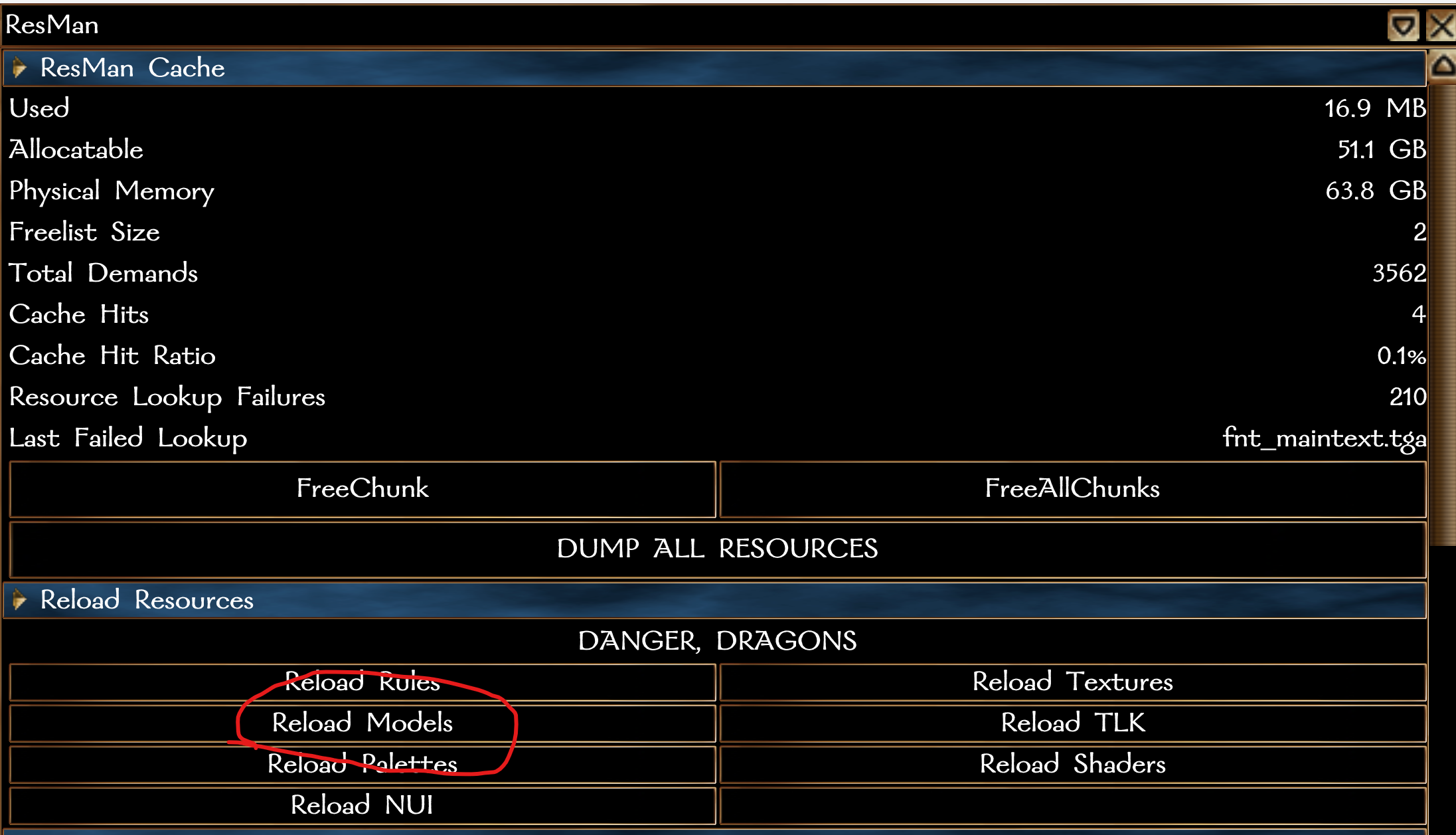
Alternatively you can keep a test module open in the toolset and load it every edit.
To run a VFX in NWN use the script window.
For visual effects in visualeffects.2da use one of these lines replacing 100 with the ID of the relevant visualeffects.2da or vfx_persistent.2da line (uncomment or don't copy in the others as needed) or alternatively edit a spell script and use the second option (may be useful to line up hand animations for beams etc.). Make sure to include a creature nearby for the VFX to target.
For persistent effects simply rest and it will remove them since they're magical.
| Code Block |
|---|
object oCaster = GetFirstPC();
object oTarget = GetNearestCreature(4, 1, oCaster);

// Instant effects (target)
ApplyEffectToObject(DURATION_TYPE_INSTANT, EffectVisualEffect(100), oTarget);

// Duration effects
ApplyEffectToObject(DURATION_TYPE_PERMANENT, EffectVisualEffect(100), oTarget);

// Beam effects
ApplyEffectToObject(DURATION_TYPE_TEMPORARY, EffectBeam(100, oCaster, BODY_NODE_HAND), oTarget, 6.0);

// Instant effects (ground)
ApplyEffectAtLocation(DURATION_TYPE_INSTANT, EffectVisualEffect(100), GetLocation(oTarget));

// AOE effects (ground)
ApplyEffectAtLocation(DURATION_TYPE_PERMANENT, EffectAreaOfEffect(100), GetLocation(oTarget)); |
For visual effects in spells.2da or if you are using an edited spell script, use this to cast a spell at the nearest creature (replace 100 with the spells.2da line):
| Code Block |
|---|
object oCaster = GetFirstPC();
object oTarget = GetNearestCreature(4, 1, oCaster);

AssignCommand(oCaster, ActionCastSpellAtObject(100, oTarget, 0, TRUE)); |
New VFX in EE
Some basic recommendations for visual effect editing for EE:
- Compile your VFX models when you are finished. You can do this for VFX not on screen by running the command compilemodel MODELNAME in the console. See Models for examples. VFX need to be loaded quickly and compiling speeds up any loading of them significantly since they are not retained in memory for long after use.
- You can cache the VFX models clientside (which might even cache the textures) with cachedmodels.2da if using 1.89.8193.37 or later.
- Use DDS textures - they should load faster and can be of larger sizes then TGA for similar quality, and have built in mipmaps (see below)
- Check out progfx.2da which adds a lot of options for visual effects, such as new beams or MIRV missiles
Note that while Bioware regularly disabled mipmaps using a TXI file for their VFX texture files due to them being TGA, this is redundant nowadays with how fast mipmap loading is with DDS files and that cachemodels.2da exists to preload models. Remember bigger sized DDS is more optimal in an engine than a smaller "uncompressed so full quality" TGA.
Editing Bioware's VFX
The VFX including in the game made by Bioware are usually compiled, so the easiest way usually to extract one you want to mess with quickly is NWN Explorer. Alternatively extract them all and run them through nwnmdlcomp since they're compiled for 1.69 edition and work with that decompiler.
Most of them should be recognisable names and tweaking them can be a good start to having size-appropriate VFX of a similar kind to what you want. Adding new textures, adjusting the spawn rates or colouring, and lighting effects are useful ways to remake a VFX into what you need.
Editing Notes
These are some notes on how to deal with specific Visual Effect use cases and what some nuances of the emitter system are.
Black or Grey Emitter base VFX
There is some nuance to getting Black or Grey VFX. By default a lot of Bioware VFX use transparent textures - great since we don't want big square blotches - but when you use blend Lighten which most do, the emitters use the colorStart/End to lighten the texture (acting like real light, ie you can't do "black light" only white-red-green-blue).
Instead change it to blend Normal and you can then use the colorStart and colorEnd properties. For instance, cropping out most of the emitter info, you'd use this:
| Code Block |
|---|
node emitter EmitterName
...
  texture fxpa_smoke01   # Must be a texture with an alpha layer (DDS or TGA)
  blend Normal           # Required so it doesn't turn some amount of white (where colorStart and colorEnd mainly determine the brightness)
  colorStart 0.3 0.3 0.3 # Start dark grey
  colorEnd 0.2 0.2 0.2   # End a bit lighter grey
...
endnode |