| Patch Version | 1.83.8193.21 |
| Patch release date (PC) | 2021-03-12 |
| Patch release date (Others) | |
| Patch release notes | https://steamcommunity.com/games/704450/announcements/detail/4622354803159314301 |
Beta patch release.
Fair greetings, one and all!
This development build is a huge one. As usual, you can use it to play on .20.1 servers (current stable release); and we’d like to encourage you to do so and report any issues you find with us!
Thank you.
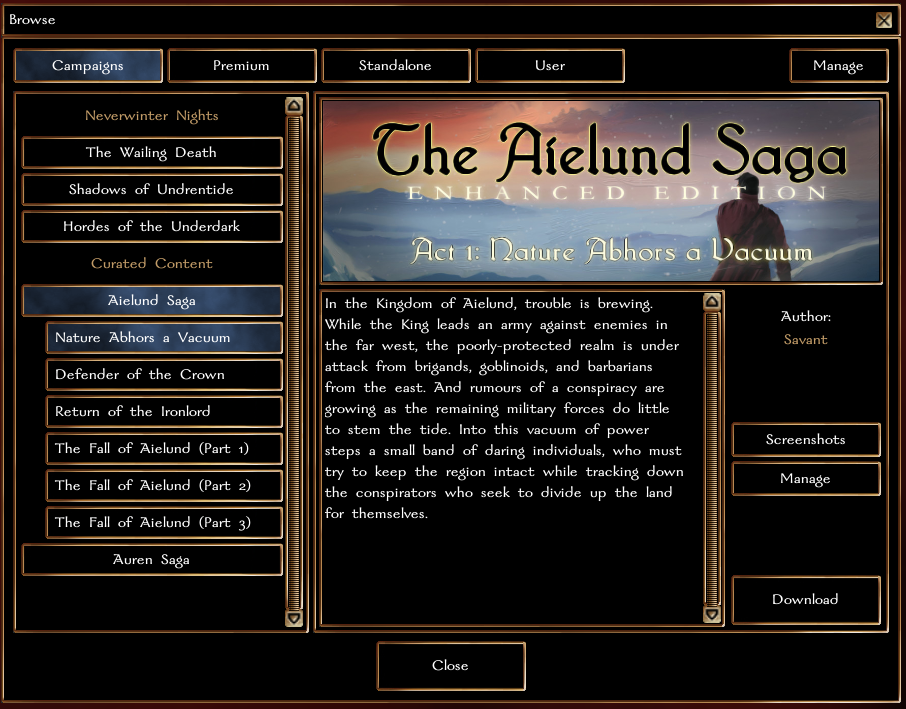
This patch ships with a new (singleplayer) game launcher UI. It showcases all campaigns and premiums in a nicer way, with header images and descriptions; access to screenshots, and more. There is a split view for Premium and user modules, as well as filtering and search facilities.
We also bring in a curated content repository, hosted by Beamdog, that gives all players access to selected community content.
To start with, we are honoured to offer both the full Aielund Saga by Savant, and the Auren Saga (Almraiven/Shadewood) by Fester Pot.
All you need to do to play them is click Download and wait a bit.
As part of this development patch release cycle, we will be reaching out to others that have authored widely popular modules on the Neverwinter Vault and elsewhere.
The UI also allows adding third party content repositories, which can be hosted by anyone without going through the Beamdog curation process.
This new UI, and the curated content repository bundled with the game now, is a work in progress. We will be making changes and improvements in the future.
The game now supports TTF fonts, and decimal UI scaling (e.g. 1.3x, not just 1x, 2x).

Visual effects applied via scripting can now lerp. This means that, for example, a creature size change can appear smoothly over a configured time, and not instant.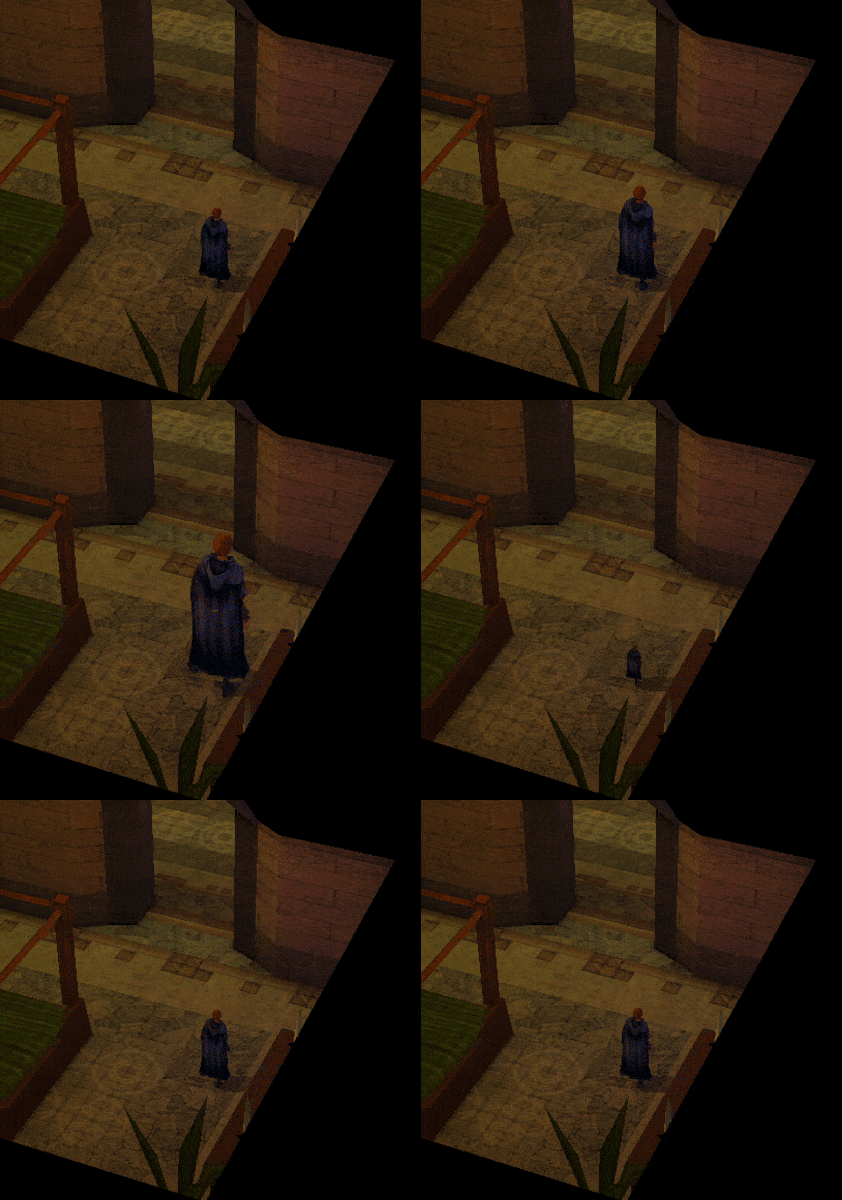
All existing visual transforms can be interpolated this way.
To accommodate this, the script API has been amended:
float SetObjectVisualTransform(object oObject, int nTransform, float fValue, int nLerpType = OBJECT_VISUAL_TRANSFORM_LERP_NONE, float fLerpDuration = 0.0, int bPauseWithGame = TRUE); int OBJECT_VISUAL_TRANSFORM_LERP_NONE = 0; // 1 int OBJECT_VISUAL_TRANSFORM_LERP_LINEAR = 1; // x int OBJECT_VISUAL_TRANSFORM_LERP_SMOOTHSTEP = 2; // x * x * (3 - 2 * x) int OBJECT_VISUAL_TRANSFORM_LERP_INVERSE_SMOOTHSTEP = 3; // 0.5 - sin(asin(1.0 - 2.0 * x) / 3.0) int OBJECT_VISUAL_TRANSFORM_LERP_EASE_IN = 4; // (1 - cosf(x * M_PI * 0.5)) int OBJECT_VISUAL_TRANSFORM_LERP_EASE_OUT = 5; // sinf(x * M_PI * 0.5) int OBJECT_VISUAL_TRANSFORM_LERP_QUADRATIC = 6; // x * x int OBJECT_VISUAL_TRANSFORM_LERP_SMOOTHERSTEP = 7; // (x * x * x * (x * (6.0 * x - 15.0) + 10.0)) |
// Returns the currently executing event (EVENT_SCRIPT_*) or 0 if not determinable.
// Note: Will return 0 in DelayCommand/AssignCommand. ExecuteScript(Chunk) will inherit their event ID from their parent event.
int GetCurrentlyRunningEvent();

// Get the integer parameter of eEffect at nIndex.
// * nIndex bounds: 0 >= nIndex < 8.
// * Some experimentation will be needed to find the right index for the value you wish to determine.
// Returns: the value or 0 on error/when not set.
int GetEffectInteger(effect eEffect, int nIndex);

// Get the float parameter of eEffect at nIndex.
// * nIndex bounds: 0 >= nIndex < 4.
// * Some experimentation will be needed to find the right index for the value you wish to determine.
// Returns: the value or 0.0f on error/when not set.
float GetEffectFloat(effect eEffect, int nIndex);

// Get the string parameter of eEffect at nIndex.
// * nIndex bounds: 0 >= nIndex < 6.
// * Some experimentation will be needed to find the right index for the value you wish to determine.
// Returns: the value or "" on error/when not set.
string GetEffectString(effect eEffect, int nIndex);

// Get the object parameter of eEffect at nIndex.
// * nIndex bounds: 0 >= nIndex < 4.
// * Some experimentation will be needed to find the right index for the value you wish to determine.
// Returns: the value or OBJECT_INVALID on error/when not set.
object GetEffectObject(effect eEffect, int nIndex);

// Get the vector parameter of eEffect at nIndex.
// * nIndex bounds: 0 >= nIndex < 2.
// * Some experimentation will be needed to find the right index for the value you wish to determine.
// Returns: the value or {0.0f, 0.0f, 0.0f} on error/when not set.
vector GetEffectVector(effect eEffect, int nIndex);

// Check if nBaseItemType fits in oTarget's inventory.
// Note: Does not check inside any container items possessed by oTarget.
// * nBaseItemType: a BASE_ITEM_* constant.
// * oTarget: a valid creature, placeable or item.
// Returns: TRUE if the baseitem type fits, FALSE if not or on error.
int GetBaseItemFitsInInventory(int nBaseItemType, object oTarget);

// Get oObject's local cassowary variable reference sVarName
// * Return value on error: empty solver
// * NB: cassowary types are references, same as objects.
// Unlike scalars such as int and string, solver references share the same data.
// Modifications made to one reference are reflected on others.
cassowary GetLocalCassowary(object oObject, string sVarName);

// Set a reference to the given solver on oObject.
// * NB: cassowary types are references, same as objects.
// Unlike scalars such as int and string, solver references share the same data.
// Modifications made to one reference are reflected on others.
void SetLocalCassowary(object oObject, string sVarName, cassowary cSolver);

// Delete local solver reference.
// * NB: cassowary types are references, same as objects.
// Unlike scalars such as int and string, solver references share the same data.
// Modifications made to one reference are reflected on others.
void DeleteLocalCassowary(object oObject, string sVarName);

// Clear out this solver, removing all state, constraints and suggestions.
// This is provided as a convenience if you wish to reuse a cassowary variable.
// It is not necessary to call this for solvers you simply want to let go out of scope.
void CassowaryReset(cassowary cSolver);

// Add a constraint to the system.
// * The constraint needs to be a valid comparison equation, one of: >=, ==, <=.
// * This implementation is a linear constraint solver.
// * You cannot multiply or divide variables and expressions with each other.
// Doing so will result in a error when attempting to add the constraint.
// (You can, of course, multiply or divide by constants).
// * fStrength must be >= CASSOWARY_STRENGTH_WEAK && <= CASSOWARY_STRENGTH_REQUIRED.
// * Any referenced variables can be retrieved with CassowaryGetValue().
// * Returns "" on success, or the parser/constraint system error message.
string CassowaryConstrain(cassowary cSolver, string sConstraint, float fStrength = CASSOWARY_STRENGTH_REQUIRED);

// Suggest a value to the solver.
// * Edit variables are soft constraints and exist as an optimisation for complex systems.
// You can do the same with Constrain("v == 5", CASSOWARY_STRENGTH_xxx); but edit variables
// allow you to suggest values without having to rebuild the solver.
// * fStrength must be >= CASSOWARY_STRENGTH_WEAK && < CASSOWARY_STRENGTH_REQUIRED
// Suggested values cannot be required, as suggesting a value must not invalidate the solver.
void CassowarySuggestValue(cassowary cSolver, string sVarName, float fValue, float fStrength = CASSOWARY_STRENGTH_STRONG);

// Get the value for the given variable, or 0.0 on error.
float CassowaryGetValue(cassowary cSolver, string sVarName);

// Gets a printable debug state of the given solver, which may help you debug
// complex systems.
string CassowaryDebug(cassowary cSolver);

// Overrides a given strref to always return sValue instead of what is in the TLK file.
// Setting sValue to "" will delete the override
void SetTlkOverride(int nStrRef, string sValue="");

// Constructs a custom itemproperty given all the parameters explicitly.
// This function can be used in place of all the other ItemPropertyXxx constructors
// Use GetItemProperty{Type,SubType,CostTableValue,Param1Value} to see the values for a given itemproperty.
itemproperty ItemPropertyCustom(int nType, int nSubType=-1, int nCostTableValue=-1, int nParam1Value=-1); |